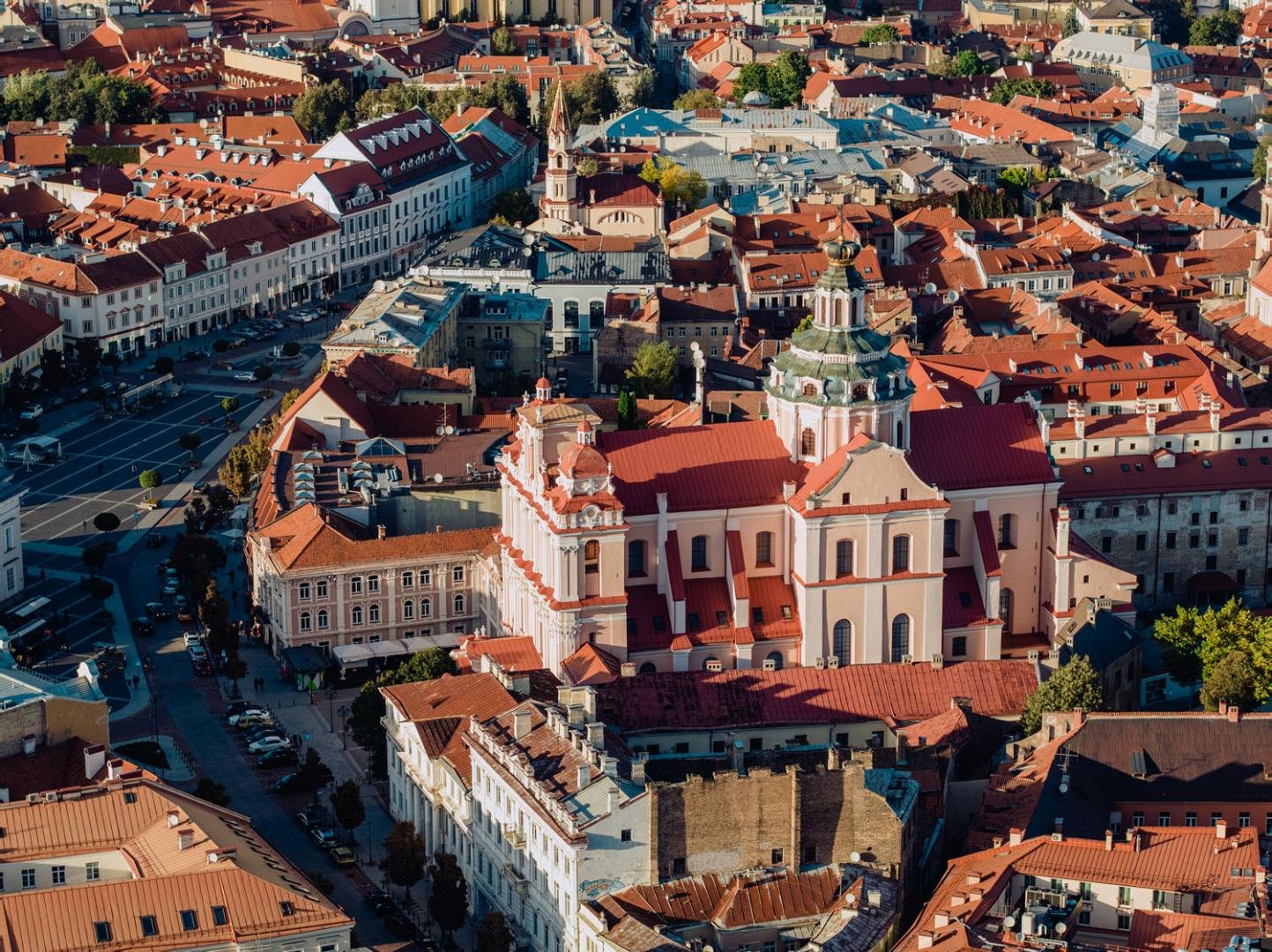
General Information
Lithuania, officially the Republic of Lithuania, is a country in the Baltic region of Europe. It is one of three Baltic states and lies on the eastern shore of the Baltic Sea, bordered by Latvia to the north, Belarus to the east and south, Poland to the south, and the Russian semi-exclave of Kaliningrad Oblast to the southwest, with a maritime border with Sweden to the west. Lithuania covers an area of 65,300 km2 (25,200 sq mi), and has a population of 2.9 million. Its capital and largest city is Vilnius; other major cities include Kaunas, Klaipėda, Šiauliai and Panevėžys. Lithuanians are the titular nation, belong to the ethnolinguistic group of Balts, and speak Lithuanian.
- Population: 2,800,000+
- Area: 65,300 km²
- Coordinates: Latitude: 54.683334350586, Longitude: 25.316667556763
- Timezone: Timezone info not available
- Current Local Time: ailab
Latest Lithuania News
15min.lt RSS - suprasti akimirksniu | RSS
Karo istorikas: Rusijoje prasidėjo emigracijos banga – kaip ir prieš 100 metų
Rusijos gyventojai vis dažniau paieškos sistemoje „Google“ ieško informacijos apie galimybes išvykti iš šalies. Dabar tokių paieškų skaičius pasiekė 2023 m. lygį. Kaip komentare leidiniui „Postimees“ konstatuoja karo istorikas Juris Kotšinevas, prasidėjo nauja emigracijos iš Rusijos banga – kokia šalyje buvo kilusi ir prieš šimtmetį.
15min.lt RSS - suprasti akimirksniu | RSS
Parlamento rinkimai Latvijoje: užsidarius apylinkėms, apklausos rodo A. Kulbergo pergalę
Latvijos ministro pirmininko Andrio Kulbergo centristinis ir Ukrainą remiantis „Jungtinis sąrašas“ (Apvienotais saraksts) šeštadienį vykusiuose parlamento rinkimuose išsiveržė į priekį, rodo balsavusiųjų apklausos, praneša „Reuters“.
BBC News
Russia hits second major bridge in Ukraine's capital Kyiv
The strike on the Pivnichnyi (Northern) Bridge comes after repeat attacks on another major bridge in Ukraine's capital.
BBC News
'Anger in the streets': Tens of thousands protest in Spain over housing crisis
More than 50 protests are taking place on Saturday after the government failed to get emergency legislation through parliament.
BBC News
G7 to release millions of barrels of oil and diesel after Trump threat
The co-ordinated release is aimed at heading off further price spikes and avoiding a ban on US diesel exports.
BBC News
Suppliers pile pressure on government over energy bills
Immediate action is needed to help households struggling with bills this winter, says trade body Energy UK.
POLITICO
Two Iranians charged with alleged bomb plot against Britain’s Jewish community
Two Iranian men have been charged with terror offenses over an alleged plot to bomb Manchester’s Jewish community. Rahman Salehi, 34, and Salam Ahmadyan, 36, appeared in a British court on Saturday on charges of preparing to commit an act of terrorism or assisting another to commit an act of terrorism. Police said the two men, who were arrested last month on the eve of the Jewish holiday of Yom Kippur, had received material and instructions on how to make a bomb, identified targets and carried out reconnaissance ahead of an attack on Jewish targets. They also said another man, likely in Iran, was in contact with them over the plot. The arrests followed a joint investigation by counter-terrorism police and the MI5 secret services. The latest charges follow Prime Minister Andy Burnham announcing there were “strong indications” that Iran was involved in a suspicious incident linked to the RAF Fairford last week, which involved three vans parked strangely and a group of hooded, masked men near the airbase. Britain’s deputy assistant commissioner for counter-terrorism Vicki Evans said the last week has “brought into sharp focus some of the wider threats being projected into the UK from Iran,” while adding the two incidents “are not connected in any way.” British Home Secretary Shabana Mahmood said both men had arrived to Britain via small boats in 2020 and 2023. One had been granted asylum and the other had an asylum application pending.
POLITICO
Spaniards protest housing crisis as Sánchez weighs snap vote
A wave of housing protests swept across dozens of Spanish cities on Saturday as Prime Minister Pedro Sánchez weighed calling a snap election. The largest demonstration took place in Madrid, where four columns of protesters filled the capital’s main boulevards before converging on Cibeles Square. The Spanish Tenants Union, which organized the protests, said 500,000 people took to the streets, while the government’s delegation in Madrid estimated 70,000 protesters participated. Spanish Tenants Union spokesperson Valeria Racu said the turnout reflected public exasperation with political leaders who have failed to tackle a housing crisis in which average rents have risen nearly 90% over the past decade. “The people on the streets once again hold the power,” she said while addressing the demonstration, insisting that their movement would “no longer tolerate inaction.” The protests were triggered after an investment firm evicted 87-year-old Maricarmen Abascal from the apartment where she had lived since 1956. Sánchez’s government sought to contain the discontent on Tuesday by unveiling two long-delayed bills aimed at curbing speculative practices, extending eviction protections for vulnerable tenants and automatically renewing existing contracts. But conservative lawmakers in parliament rejected both bills on Friday. Amid the defeat, senior government figures indicated Sánchez — already under pressure over the ongoing migrant crisis in Ceuta and corruption cases involving members of his family and close political allies — was considering calling a snap election in a bid to capitalize on anger over housing. Protesters hold a banner reading ‘towards the general strike’ along Gran Via street during a demonstration against the housing crisis on October 3, 2026 in Madrid. | Pablo Blazquez Dominguez/Getty Images Saturday’s protests underscored the risks of that strategy. While demonstrators slammed the conservative opposition for voting down the bills, they also accused Sánchez of failing to tackle the housing crisis since taking office in 2018. “Eight days of people power have achieved more than eight years of progressive government,” Racu said, adding that protesters would continue pressuring politicians “regardless of who governs this country.” Calling for a general strike to force the adoption of urgent housing measures, Racu said “the feelings of disaffection, desperation, disillusionment and sadness have been replaced by a new energy on the streets.” As the demonstrations took place, Sánchez remained out of sight, weighing his options. Emiliano García-Page, the Socialist president of Castilla-La Mancha, and the party’s leaders in Extremadura, the Basque Country and Castilla y León on Saturday urged Sánchez to call an early election, saying voters needed to be heard. Meanwhile, the prospect of an imminent election is prompting Spain’s fractured left to scramble to regroup. With Deputy Prime Minister Yolanda Díaz declining to run for reelection, Health Minister Mónica García and Culture Minister Ernest Urtasun are seen as frontrunners to succeed her in the leadership of the Sumar party. But Podemos leader Irene Montero is also positioning herself to lead a broader left-wing alliance. So, too, is longtime housing activist and former Barcelona Mayor Ada Colau, who has signaled a willingness to return to frontline politics at the head of a progressive coalition. The center-right People’s Party leads in electoral polls with 34% support and is open to forming a government with the far-right Vox party, which is polling at 18%. Sánchez’s Socialists are backed by 26% of voters, and would need the fragmented left to unite behind a viable electoral alliance capable of winning enough seats in parliament to form a fresh coalition. Spain’s housing protests have begun to spill beyond the country’s borders, with similar demonstrations held in Lisbon, Dublin, Potsdam and The Hague. The mobilizations reflect a bloc-wide crisis marked by the lack of affordable homes and governments under pressure to increase housing supply.
Al Jazeera – Breaking News, World News and Video from Al Jazeera
Fernandes hails Ronaldo and calls for Portugal unity ahead of Norway game
Cristiano Ronaldo withdrew from the Portugal squad, but Bruno Fernandes says forward remains team's 'greatest symbol'.
Al Jazeera – Breaking News, World News and Video from Al Jazeera
England trounce Croatia 7-0 in Nations League as Kane goal run continues
Harry Kane scores in sixth successive away game for England as Bukayo Saka also scores twice in Nations League thumping.
Europe
Iranian small-boat migrants charged over Manchester Jewish attack plot
UK Counter Terrorism Policing says the two men may have been directed from Tehran
Europe
China launches anti-dumping probe into European chemical exports
Latest tit-for-tat move follows three similar investigations launched by the EU last week
France 24 - International breaking news, top stories and headlines
Putin's war for the history books: Dmytro Kuleba speaks to France 24
The Bronze Horseman, the iconic equestrian statue in Senate Square in St Petersburg, was commissioned by Catherine the Great in honor of Peter the Great, the city's founder. The pedestal of the statue bears a laconic dedication, "To Peter the First, Catherine the Second, 1782". Does Putin want to be the third, Vladimir the Great? And is that ambition, expansion at any cost, the real reason behind the war in Ukraine? According to Former Ukrainian Foreign Minister Dmytro Kuleba, "Putin only cares about what will be written about him in history books."
France 24 - International breaking news, top stories and headlines
Tennessee prison chief who oversaw botched Christa Pike execution resigns
The head of Tennessee's prison system has resigned in the first major shake-up since the stunning failed execution of Christa Pike, who is in critical condition after surviving two lethal injections. Tennessee Governor Bill Lee, who previously denied Pike clemency, has halted further executions through the rest of the year while a review is conducted.
Africanews RSS
Loud explosions heard Yemeni capital amid reports of Saudi strikes
The internationally-recognised government says attacks target the rebel group's positions across the country.
Africanews RSS
Fuel shortage in Sudan drives up prices, burdening ordinary people
The scarcity is driven by global oil disruptions tied to the Middle East conflict and by domestic import restrictions.